how does cytokinesis differ between plant and animal cells Cytokinesis cells differ
Hey there!
Today, let’s talk about cytokinesis in plant cells and how it differs from that in animal cells. Cytokinesis is the process of cell division that occurs after the genetic material has been evenly distributed into the daughter cells. While the overall outcome of cytokinesis is the same in both plant and animal cells, there are some notable differences in the way it takes place.
Plant Cell Cytokinesis
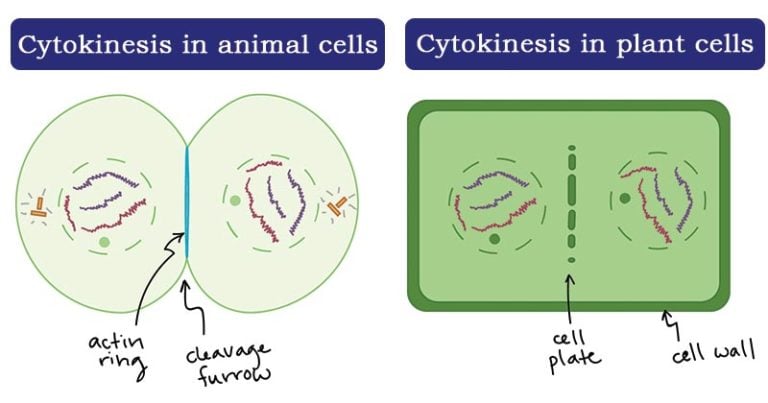
 In plant cells, cytokinesis begins with the formation of a cell plate. During telophase, which is the final stage of mitosis, Golgi vesicles containing cell wall materials gather at the equatorial plane of the cell. These vesicles fuse together to form a flattened, disc-like structure called the cell plate. As the cell plate expands toward the periphery of the cell, it creates a new cell wall between the two daughter cells.
This process of cytokinesis in plant cells is unique because it involves the formation of a new cell wall. The cell plate eventually develops into the middle lamella and primary cell wall, which are essential for providing structural support and maintaining the shape of the plant cell.
Animal Cell Cytokinesis
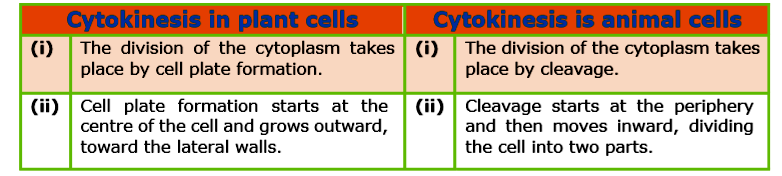 Unlike plant cells, animal cells lack a cell wall. Therefore, cytokinesis in animal cells involves the formation of a constriction called the cleavage furrow. During telophase, a contractile ring composed of actin and myosin filaments forms around the equatorial region of the cell. This contractile ring contracts in a ring-like fashion, pinching off the cytoplasm and forming two separate daughter cells.
The formation of the cleavage furrow is crucial for separating the two daughter cells. It is responsible for the physical division of the cytoplasm, organelles, and other cellular components between the daughter cells.
Conclusion
In summary, cytokinesis in plant cells differs from that in animal cells primarily due to the presence or absence of a cell wall. Plant cells form a cell plate that develops into a new cell wall, while animal cells form a cleavage furrow to physically divide into two daughter cells. These differences in cytokinesis highlight the unique adaptations and structures present in plant and animal cells.
I hope this post helps you understand the differences between cytokinesis in plant and animal cells. If you have any more questions, feel free to ask!
If you are searching about Biology 2e, The Cell, Cell Reproduction, The Cell Cycle | OpenEd CUNY you’ve visit to the right place. We have 5 Pics about Biology 2e, The Cell, Cell Reproduction, The Cell Cycle | OpenEd CUNY like Venn Diagram To Compare And Contrast Cytokinesis In Animal Cells With, Biology 2e, The Cell, Cell Reproduction, The Cell Cycle | OpenEd CUNY and also Question 37 How does cytokinesis in plant cells differ from that in. Read more:
Biology 2e, The Cell, Cell Reproduction, The Cell Cycle | OpenEd CUNY
 opened.cuny.educell cycle mitosis biology cytokinesis animal plate phase which metaphase diagram forms plant cells furrow vesicles cleavage membrane forming ring
Question 37 How Does Cytokinesis In Plant Cells Differ From That In
byjus.comVenn Diagram To Compare And Contrast Cytokinesis In Animal Cells With
 vashtisroczynskie0197859.blogspot.comHow Does Cytokinesis Differ In Plant And Animal Cells : What Is
buddyfromboss.blogspot.comcytokinesis cells differ
Cytokinesis- Definition And Process (in Animal And Plant Cells)
 microbenotes.comcytokinesis
Cell cycle mitosis biology cytokinesis animal plate phase which metaphase diagram forms plant cells furrow vesicles cleavage membrane forming ring. Venn diagram to compare and contrast cytokinesis in animal cells with. Biology 2e, the cell, cell reproduction, the cell cycle